
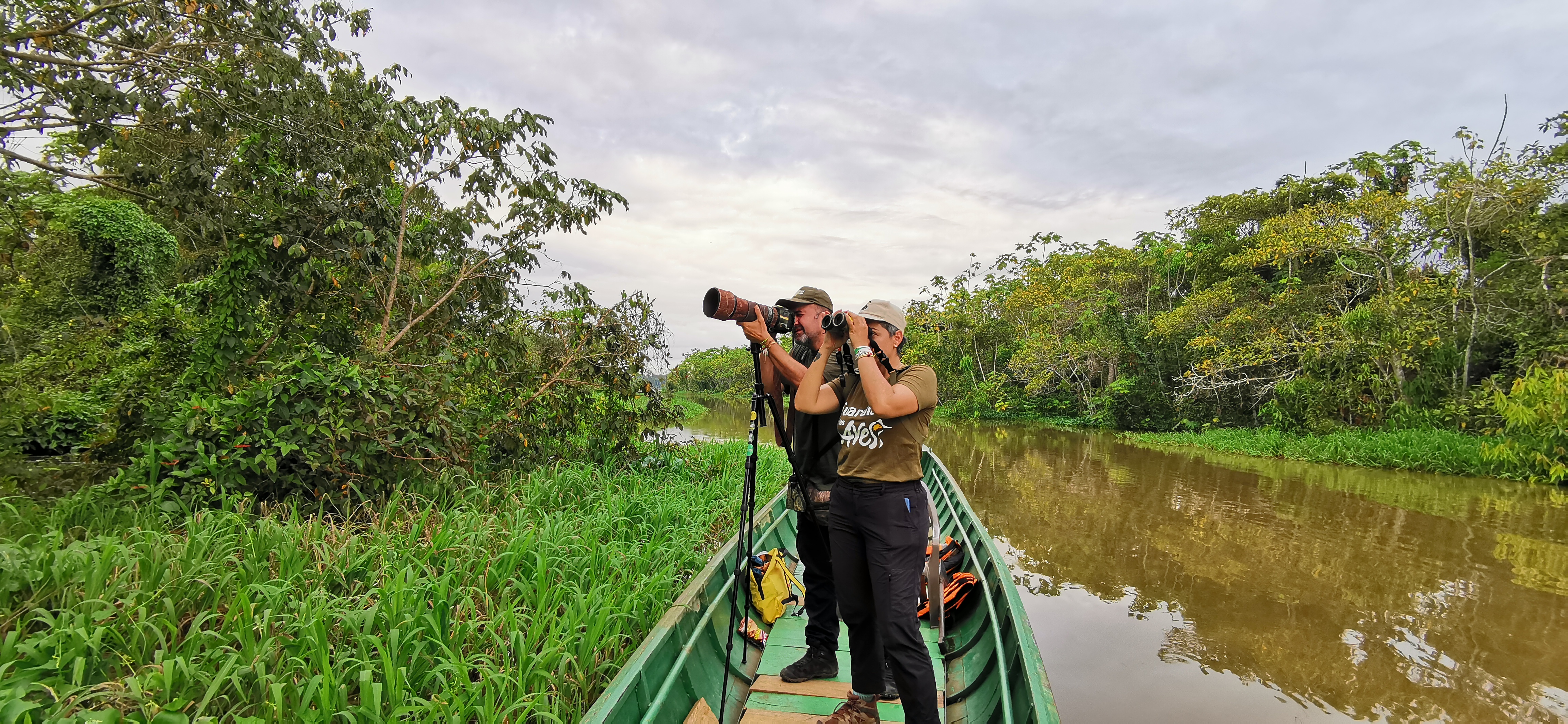

Exploring Colombia’s Amazonian waterways, where changing water levels can completely transform the birding experience.One of the questions we are asked most often by travelers thinking about coming to Colombia is: What is the best time for birding in Colombia?
But that answer needs some explanation.
One of the questions we are asked most often by travelers thinking about coming to Colombia for birding is:
When is the best time to come?
Colombia lies very close to the Equator, and that changes the way we think about seasons. We do not experience spring, summer, fall and winter in the same way as countries farther north or south.
Instead, rainfall, altitude, geography and an extraordinary variety of ecosystems create very different conditions across the country.
On the same day, we can leave a warm valley in the morning, enter a cool cloud forest a few hours later and finish surrounded by páramo vegetation high in the Andes.
And the birds change with us.
That is why, when someone asks us for the best month to go birding in Colombia, our first thought is usually another question:
What would you like to experience, and which birds would you like to find?
Colombia Is a Year-Round Birding Destination
There are birds to see in Colombia twelve months of the year.
That does not mean every month is the same.
Rainfall changes. Some roads and trails become easier or more difficult. Flowering cycles can influence hummingbird activity. Fruiting trees can suddenly become extraordinary centers of bird activity. Migratory species arrive and eventually leave again.
But there is no time of year when Colombia simply stops being a birding destination.
For us, the important thing is understanding that the best time for birding in Colombia depends much more on where you want to go and what you hope to find than on choosing one supposedly perfect month.

Sword-billed Hummingbird (Ensifera ensifera). Flowering cycles are one of the many factors that can influence bird activity throughout the year in Colombia.Understanding Rainfall in Colombia
One of the most common mistakes is thinking that Colombia has one rainy season and one dry season that apply to the entire country.
Our geography is far too diverse for that.
Across much of the Andes there are generally periods with less rainfall and others with more. But travel toward the Pacific and you enter one of the wettest regions of the country.
Travel toward La Guajira and you find almost the opposite extreme.
Amazonia and Orinoquia follow their own cycles.
So when we design a journey, we do not simply look at the calendar and say:
“This is the dry season in Colombia.”
We look at the particular region we are going to visit.
The Colombian Andes
Many of Colombia’s classic birding routes travel through the Andes.
Here, some travelers prefer periods with somewhat less rainfall because trails may be easier to walk, mornings may offer clearer conditions and traveling between locations can be more comfortable.
Generally, December through March and some periods between June and August tend to bring relatively drier conditions to different parts of the Colombian Andes, although there can be significant variations between regions and from one year to another.
But we would never interpret that as meaning the other months should be avoided.
Cloud forests are cloud forests for a reason.
Rain is part of these ecosystems.
Sometimes a cloudy morning produces beautiful light for photography. Sometimes, after a downpour, bird activity suddenly increases. And there are days when the weather changes several times before the morning is over.
That unpredictability is also part of birding in the Andes.

Mist moving through the Colombian Andes, where weather can change several times in a single morning.The Pacific and Chocó
Chocó is another story.
If we wait for a completely dry Chocó, we may be waiting for quite a while.
Rain is part of the identity of this ecosystem and one of the reasons these forests support such extraordinary biodiversity.
When we travel there, the question is not simply how to avoid the rain.
It is how to travel well in a rainforest.
That means being prepared for humidity, sudden showers, wet trails and rapidly changing light.
And then, somewhere among all that green, a Toucan Barbet, a tanager or an Andean Cock-of-the-rock appears.
Suddenly the rain does not seem quite so important.

Water, humidity and dense forest are part of the birding experience in Colombia’s Chocó.The Caribbean
Northern Colombia tells a different story.
The Caribbean includes everything from humid forests and mountains to some of the driest landscapes in the country.
La Guajira is perhaps the clearest example.
But even in northern Colombia, altitude can change everything.
The Caribbean lowlands and the mountains of the Sierra Nevada de Santa Marta can offer completely different temperatures, ecosystems and bird communities within relatively short distances.
This is one of the things we enjoy most about birding in Colombia:
Distance on a map does not always tell you how different two birding places can be.

Birding along Colombia’s Caribbean coast, where wetlands and coastal habitats create a completely different experience from the Andes.Amazonia and Orinoquia: When Water Transforms the Journey
Perhaps one of the best examples of why there is no single ideal time for birding in Colombia can be found in Amazonia and Orinoquia.
Here, rainfall does more than change the weather.
It changes the landscape and the way we explore it.
In Amazonia, during periods of high water, some forests and trails that can be explored on foot at other times of year become flooded.
The experience changes completely.
Places we once walked through may now be explored by canoe or boat.
When rainfall decreases and river levels fall, trails become accessible on foot again. The rivers themselves also change. Beaches, sandbanks and even islands begin to appear where there was previously only water.
These newly exposed areas can create opportunities to find birds associated with river edges, including different shorebirds.
Something similar happens in Orinoquia, although across very different landscapes.
Rainy and dry periods transform the savannas, wetlands, esteros, morichales and rivers. Areas covered by water during one season can look completely different when water levels fall, and the distribution and concentration of birds can change with them.
So asking which season is “better” can be far too simple.
Do we want to explore a flooded forest by canoe? Walk trails that remain underwater during other months? Explore river beaches and islands when the water drops? Experience the vast flooded landscapes of the Llanos, or discover those same landscapes during a drier period?
We are not necessarily talking about a good season and a bad season.
We are talking about different experiences.
The same destination can change dramatically depending on the level of the water.

High water transforms the Amazonian forest, turning places that can be explored on foot at other times of year into birding routes by canoe.The Sun Also Changes the Rhythm of Birding
Rain is not the only factor.
In warm regions such as the Caribbean, Amazonia and Orinoquia, very sunny days can completely change the rhythm of a birding day.
Under these conditions, we learn to make the most of the earliest hours.
We start very early, while temperatures are still comfortable and birds are usually more active.
As the morning progresses and the sun becomes stronger, activity often decreases. By around 10 a.m., the heat can become intense, both for the birds and for us.
That means that in some destinations our birding day naturally divides into two parts.
We bird intensively from early morning until mid-morning, take a break during the hottest hours and return to the field around 4 p.m., when the sun begins to lose some of its intensity and bird activity starts to increase again.
On cloudy days, that window can sometimes be longer.
And this leads to an important idea:
For a birder, “good weather” does not necessarily mean sunshine and no rain.
And Then the Migrants Arrive
There is another seasonal story happening above us.
Every year, migratory birds travel enormous distances from North America and other parts of the continent to spend part of their annual cycle in Colombia.
Warblers, thrushes, flycatchers, shorebirds and many other species temporarily join the resident birds of our forests, wetlands, coffee landscapes, rivers and gardens.
For someone visiting Colombia, this creates an interesting question.
Do you want to concentrate especially on Colombia’s resident and endemic birds?
Or would you also enjoy encountering birds you know from North America after they have traveled thousands of miles to reach Colombia?
There is no right answer.
They are simply different experiences.
Birding and Bird Photography Are Not Exactly the Same
So far, we have mostly talked about weather from a birder’s perspective.
But once we carry a camera, ideal conditions can change.
Good conditions for birding are not always the same as good conditions for bird photography.
A completely clear day may seem perfect for being outdoors.
For photography, however, that same sunshine can quickly become challenging.
When strong tropical sunlight falls directly on a bird, the contrast between highlights and shadows can become extreme. Whites can lose detail, intense colors can become difficult to expose correctly, and exposure can change dramatically when a bird moves between sunlight and shade.
And Colombia has some extraordinarily colorful birds.
Tanagers, toucans, hummingbirds, Andean Cock-of-the-rocks and many other species can become surprisingly challenging photographic subjects under strong sunlight.

Bay-headed Tanager (Tangara gyrola). Soft, diffused light can make a remarkable difference when photographing Colombia’s intensely colorful birds.That is why a partly cloudy or even overcast day can be wonderful for photography.
Clouds become an enormous natural diffuser, softening the light, reducing contrast and sometimes allowing us to photograph for longer periods.
What If It Rains at a Feeder?
Rain does not necessarily mean putting the camera away.
Many feeders and bird photography locations in Colombia have covered observation and photography areas.
We can remain protected while it rains and take advantage of the moments when the rain becomes lighter or stops.
Photographing a bird in the rain can also produce wonderful images. Raindrops, wet plumage and vegetation can create a completely different atmosphere.
And there is something else we have observed many times in the field.
After a downpour, activity around feeders can increase considerably.
The opposite can also happen in ways that may seem counterintuitive.
After several dry, sunny days, when the forest is producing abundant flowers, fruits and other natural food sources, some species may visit feeders less frequently because they are finding plenty of food in the surrounding habitat.
During wetter periods, depending on the location and the availability of natural food, feeders can once again become an attractive resource for certain species.
So rain does not necessarily mean a bad day for bird photography.
Sometimes it means photographing from under a roof while it rains.
Sometimes it means waiting for the rain to stop.
Sometimes it means taking advantage of beautiful soft light.
And sometimes it simply means photographing birds in the rain.

Many bird photography locations in Colombia have covered areas, allowing photographers to keep working even when the weather changes.There Is No Perfect Weather Forecast
There is another reason why we are cautious when someone asks us to declare one particular month “the best.”
Climate varies from year to year.
El Niño, La Niña and other climatic patterns can change the conditions we would normally expect.
Even during a period considered relatively dry, it can rain.
And during a rainy period, we can have spectacular clear mornings.
Averages help us plan.
They do not decide what will happen when we arrive.
What Is the Best Time for Birding in Colombia?
If your priority is finding generally drier trails and reducing the probability of rain in some Andean areas, relatively dry periods may be attractive.
If migratory birds are important to you, their presence can influence your dates.
If you want to experience Amazonia, river levels can completely transform the way you explore it.
If photography is your priority, the conditions you are looking for may be different from those preferred by someone whose main objective is seeing as many species as possible.
And if you are looking for particular endemic birds or want to explore a specific region, those priorities may be much more important than simply choosing the month with the least rain.
Sometimes our answer becomes much simpler:
Come when you have the opportunity to come.
Colombia is not a destination where the birds disappear for half the year.
The country changes throughout the year.
And those changes are part of the experience.
How We Choose Our Dates
When we design a private journey with our travelers, we begin with the birds and the experience they want to have.
That is why, for us, choosing the best time for birding in Colombia starts with understanding each traveler’s priorities.
Which species would they particularly like to find?
Which regions interest them?
Are they birders, photographers or both?
Do they prefer long days in the field or a slower pace?
Only then do we begin thinking about the route and the dates.
Because after years of traveling across Colombia following birds, we have learned something:
In Colombia, there are not necessarily good and bad seasons for birding. There are different seasons that change the landscapes, the birds and the way we find them.
There may not be one single best time for birding in Colombia.
But there can be a very good time for the journey you want to make.

Every season brings a different way of experiencing Colombia. The best time to come depends on the journey you want to make.Niky & Mauro
Birds Experience