
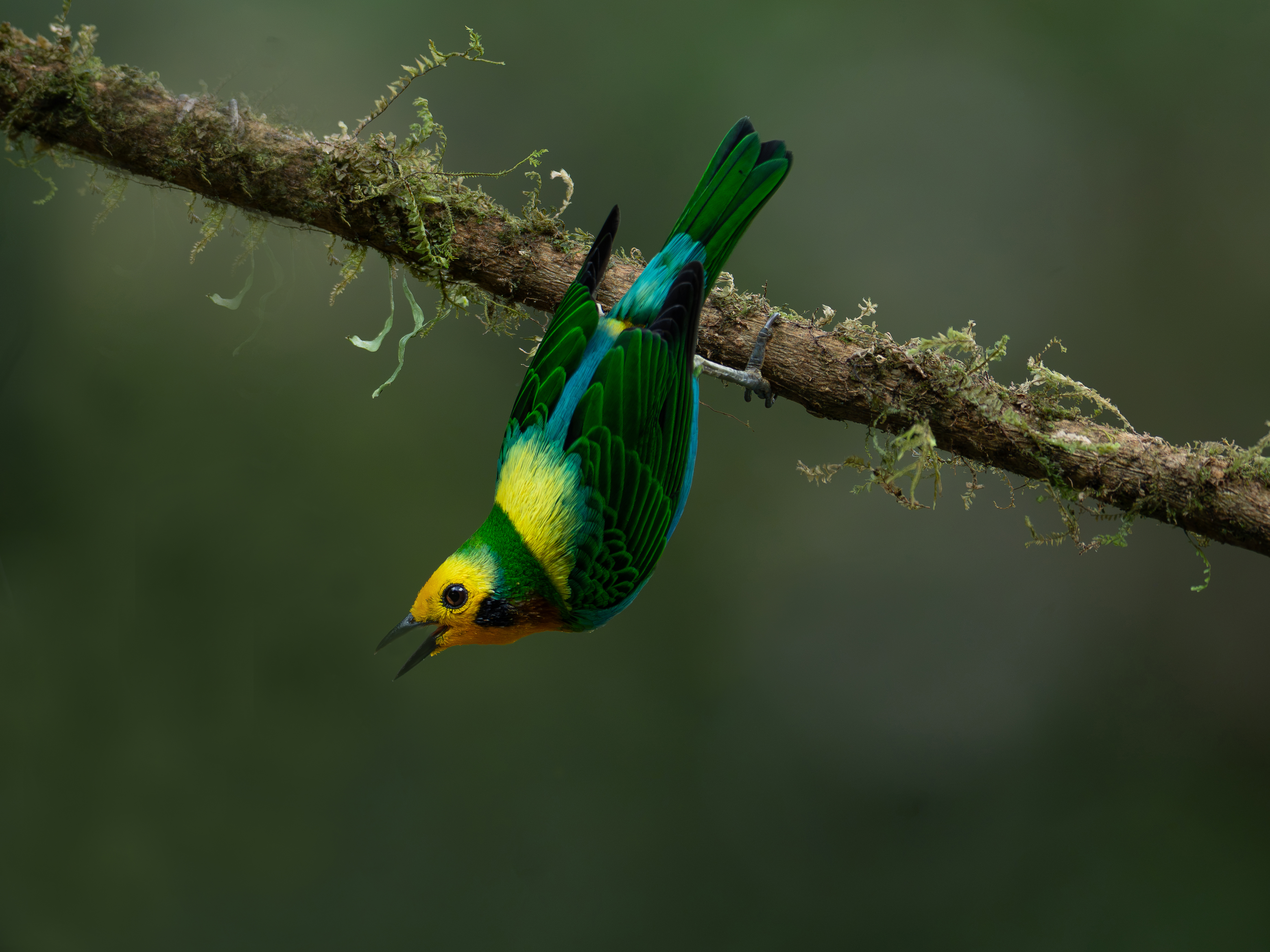
From cloud forests and hummingbird gardens to wax palm valleys and high-Andean páramo, Colombia offers an extraordinary variety of settings for bird photography.
Bird photography in Colombia offers an extraordinary combination of bird diversity, landscapes and photographic opportunities. But when we travel with our cameras, the number of species is only part of the story.
For us, a great place for bird photography needs something more.
Good light. The right distance. Clean or interesting backgrounds. Natural perches. Birds that give us enough time to observe their behavior. And sometimes, a landscape that becomes just as important to the photograph as the bird itself.
After years of traveling and working with bird photography in Colombia, we have learned that every region invites us to photograph in a different way.
In some places, we can sit quietly near a feeder and wait for a hummingbird to return to the same perch. In others, we walk through cloud forest looking for an antpitta in the soft morning light. And sometimes we simply stand on a mountainside waiting for a flock of parrots to cross a valley filled with wax palms.
These are some of the places and landscapes where we most enjoy photographing birds in Colombia.
The Western Andes: Photography in the Cloud Forest
The mountains west of Cali are one of those places where bird photography can become wonderfully intense.
Humid forests, remarkable bird diversity, feeders and natural perches create excellent opportunities to work with hummingbirds, tanagers and other cloud forest species at relatively close range while still keeping natural backgrounds.
One of the places we enjoy in this region is La Florida, where we can slow down and spend time with each photographic opportunity.
Species such as Multicolored Tanager, Long-tailed Sylph, Booted Racket-tail, Andean Emerald and even Chestnut Wood-Quail make this part of the Western Andes particularly rewarding for photography.
But what we especially enjoy here is the combination of color and forest.
The challenge is not simply getting the bird into the frame. It is finding that moment when the bird, perch, background and light all work together.

Multicolored Tanager, one of the colorful highlights of the Western Andes cloud forest.The Chocó: Color, Forest and the Andean Cock-of-the-rock
As we move toward Colombia’s Pacific slope, the photographic world changes again.
The Chocó biogeographic region is humid, intensely green and home to an extraordinary community of birds.
At Doña Dora, a family-run reserve we know well, feeders, forest edges and natural perches create opportunities to photograph species such as Toucan Barbet, Glistening-green Tanager, Empress Brilliant, Rufous-throated Tanager and Silver-throated Tanager.
And then there is one of the great photographic experiences of the Colombian Andes: the Andean Cock-of-the-rock.
Photographing this remarkable bird is very different from waiting beside a feeder. We enter its world, surrounded by forest, watching for those intense flashes of red-orange among the vegetation.
It is one of those birds that can make you forget about everything else for a while.
Here, patience is rewarded.
Birds appear and disappear through the vegetation, the light changes quickly, and moving only a few steps can completely transform the background of a photograph.
For us, that unpredictability is part of the beauty of photographing in the Chocó.

Andean Cock-of-the-rock, one of the most striking birds to photograph in Colombia’s Chocó forests.The Cauca Valley: A Different Landscape, Different Birds
Not every great bird photography location in Colombia is inside a cloud forest.
As we descend into the Cauca Valley, the vegetation, climate and bird communities change. And so do our photographs.
At Hacienda El Diamante, gardens, feeders and nearby forest allow us to work with the birds of this landscape. More than 300 species have been recorded in the area, with photographic possibilities including Bar-crested Antshrike, Crested Bobwhite, Apical Flycatcher and Ruby-topaz Hummingbird.
Moving through different elevations is one of the great advantages of photographing birds in Colombia.
Sometimes a relatively short journey can completely change the birds appearing in front of our cameras.

Crested Bobwhite, photographed in the gardens and forest habitat of Hacienda El Diamante.Bird Photography in Colombia’s Coffee Region
The Coffee Region is our home, and it is also one of the landscapes we most enjoy sharing.
Coffee plantations, gardens, mature trees, forest fragments and the foothills of the Central Andes create a mosaic of habitats that is particularly interesting for bird photography.
At Machángara, in Quindío, dedicated photography areas and feeders allow us to spend time working with the birds visiting the property.
Photographic possibilities include Great Antshrike, Colombian Piculet, Andean Motmot, Rufous-tailed Jacamar and White-vented Plumeleteer.
But there is another reason we enjoy photographing birds in this region.
The coffee landscape is not simply a background. The countryside, gardens, people and birds are connected, and photography can become a way of telling that larger story.

Great Antshrike, photographed among the gardens and forest of Colombia’s Coffee Region.Wax Palm Forests: When the Landscape Becomes Part of the Photograph
Some birds invite us to get closer.
Others are better photographed by taking a few steps back.
The Yellow-eared Parrot is a perfect example.
In the mountains of the Central Andes around Anaime, these parrots move through a landscape dominated by enormous wax palms.
Here, the photographic experience changes completely.
We are no longer working around feeders or prepared perches. We photograph the parrots in their natural environment, flying across the mountains and moving among the palms they depend on.
Suddenly, filling the frame with the bird is not necessarily the objective.
A small flock crossing a vast Andean landscape can tell a much more powerful story.
These become photographs about habitat, scale and conservation, as much as they are photographs of birds.

Yellow-eared Parrot among the wax palm forests of Anaime, a landscape closely connected to the species’ conservation story.Hummingbirds of the Central Andes
Few birds challenge a photographer quite like hummingbirds.
Their speed, iridescent plumage and constant movement can be frustrating, addictive and extraordinarily rewarding.
At places such as El Retorno del Colibrí, feeders, flowering gardens and carefully positioned perches allow us to work differently.
Instead of chasing the bird with the camera, we can observe.
Which perch does it return to? Where is the light coming from? What happens to the background if we move a little? Which flowers is it visiting?
Among the species we may encounter are Tolima Blossomcrown, Indigo-capped Hummingbird, Shining-green Hummingbird, White-tipped Sicklebill and other birds of the Central Andes.
This kind of photography has taught us something we value enormously:
Sometimes the best thing a bird photographer can do is wait.

White-tipped Sicklebill, a distinctive hummingbird of the humid forests of Colombia’s Central Andes.Manizales: Entering the High-Andean Forest
As we climb higher into the Central Andes around Manizales, the photographic atmosphere changes again.
The temperature drops. The forests become wetter. Mist begins to become part of the landscape. And the birds change too.
Places such as El Color de mis reves bring mountain species to feeders and natural perches, with possibilities including Black-billed Mountain-Toucan, Blue-capped Tanager, Sword-billed Hummingbird, Buff-tailed Coronet and Chestnut-naped Antpitta.

Sword-billed Hummingbird, an extraordinary high-Andean hummingbird with a bill longer than its body.Nearby, Owl’s Watch, at Río Blanco, offers something completely different.
Here, inside the cloud forest, the experience becomes quieter and more intimate. Antpittas are among the main subjects, including Long-tailed Sylph, Brown-banded, Chestnut-crowned and Slate-crowned Antpittas.
These are photographs we often make in soft light, surrounded by vegetation.
And we love that.
Not every bird photograph needs perfect sunshine. Cloud forest has its own atmosphere, and sometimes it is precisely the mist, shadows and subdued light that give an image its character.

Long-tailed Sylph, one of the most spectacular hummingbirds to photograph in Colombia’s Andean cloud forests.Hacienda El Bosque: Mountain-Toucans and Antpittas
At higher elevation, Hacienda El Bosque offers another combination we enjoy enormously: remarkable birds and the opportunity to spend time with them.
Species we may encounter here include Gray-breasted Mountain-Toucan, Crescent-faced Antpitta, Barred Fruiteater, Purple-backed Thornbill and Sword-billed Hummingbird.
But what makes places like this especially valuable is time.
When we are not rushing after the next species, we can stay with one bird.
Watch how it moves.
Try another angle.
Wait for the background to change.
Miss a photograph and try again.
That freedom is one of the great differences between birding with a camera and traveling specifically for bird photography.

Gray-breasted Mountain-Toucan, one of the distinctive birds of Colombia’s high-Andean forests.Los Nevados: Photographing Birds Above the Forest
Eventually, the forest disappears and we enter a completely different world.
The páramo.
At the highest elevations of the Central Andes, the landscape opens into volcanic mountains, frailejones, low vegetation and weather that can change in a matter of minutes.
This is the world of birds adapted to life at high elevations.
At Termales del Ruiz and Los Nevados, photographic possibilities include Buffy Helmetcrest, Rainbow-bearded Thornbill, Shining Sunbeam, Great Sapphirewing, Stout-billed Cinclodes and Many-striped Canastero.
The Buffy Helmetcrest is particularly special.
But again, the bird is only part of the photograph.
The páramo deserves to be photographed too.
Clouds can cover the mountains within minutes. Light appears and disappears. A bird perched on a frailejón can tell us much more about where it lives than the same bird isolated against a perfectly smooth background.
And this brings us back to something we have learned many times while photographing birds:
Sometimes the habitat is part of the portrait.

Buffy Helmetcrest, a high-Andean hummingbird photographed in the páramo of Los Nevados.So, Where Is the Best Place for Bird Photography in Colombia?
We don’t think there is just one.
And perhaps that is precisely one of Colombia’s greatest photographic strengths.
On a single journey, we can move from humid forests filled with colorful tanagers to hummingbird gardens, agricultural valleys, wax palm forests, mist-covered high-Andean forests and finally the open landscape of the páramo.
Each place asks something different of us as photographers.
Sometimes speed.
Sometimes patience.
Sometimes technical precision.
And sometimes simply putting the camera down for a few minutes and understanding the landscape surrounding the bird.
That is the Colombia we enjoy photographing.
And the Colombia we love sharing.
Would You Like to Photograph These Places With Us?
Many of the places in this Field Note are part of our Bird Photography Experience, a 12-day journey created for bird photography in Colombia, following the way we ourselves enjoy photographing birds.
Small groups, enough time at each location, different elevations and habitats, and the freedom to work with the birds, light, backgrounds and conditions each day gives us.
Bird Photography Experience 2027
April 5–16, 2027
12 days · 11 nights
Limited to 6 guests
Hosted and guided by Niky & Mauro
EXPLORE THE BIRD PHOTOGRAPHY EXPERIENCE →
Niky & Mauro
Birds Experience